This week work simply continues on a variety of topics.
And one big change: For now we probably will switch to roughly monthly updates instead of weekly because there is so much work yet to be done in the background of our framework and custom engine that I fear that weekly updates will simply feel to irrelevant. Be assured this does not mean that work slows down… it just gets more focussed on things that matter.
As soon as I feel that update posts get too long and extensive we’ll again return to a somewhat shorter time frame between updates.
Started mouse integration
So far the game has been mostly usable via keyboard only (except for tooltips). I have started the work to extend my framework so that mouse clicks can be used everywhere. Contrary to my initial estimate it takes far more effort to extend my framework with this feature than I had expected. Therefore this story will continue for a while as I add more and more mouse support.
Sadly some early architectural decisions that worked splendidly with a keyboard-only game now return to bite me and I yet have to find smart ways to get the ensuing trouble under control. But eventually Realms of Ancardia hopefully will be completely and easily playable by mouse. Stay tuned!
Color scheme improvements
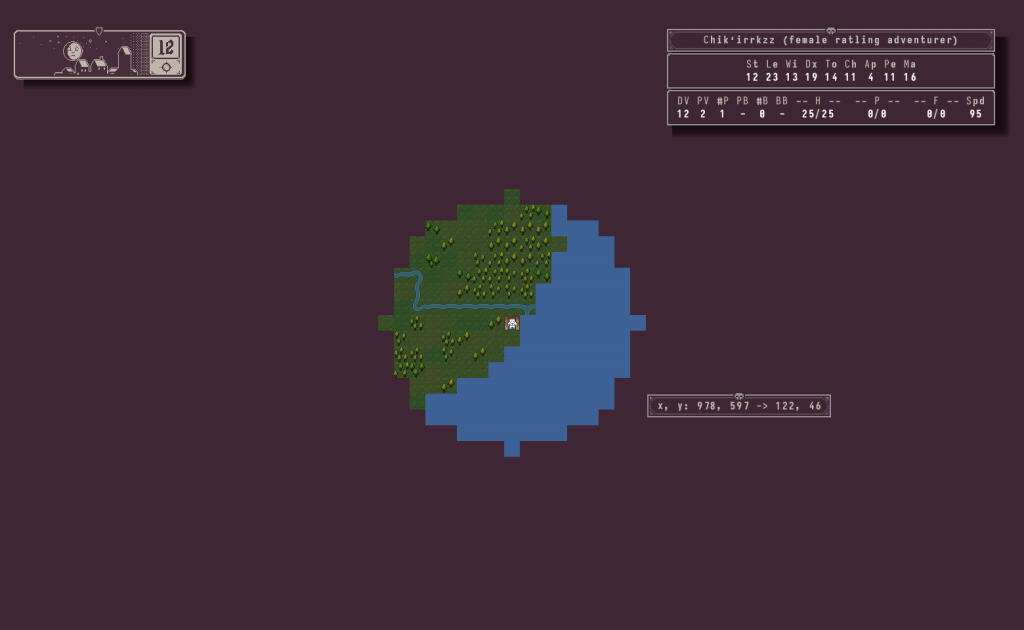
We have changed the color scheme to feel a bit more consistent and darker.
Before:
After:
(yeah, my bad – I forgot to take a “before” image and thus had to use an older screenshot that also lacks the border lines – sorry for that)
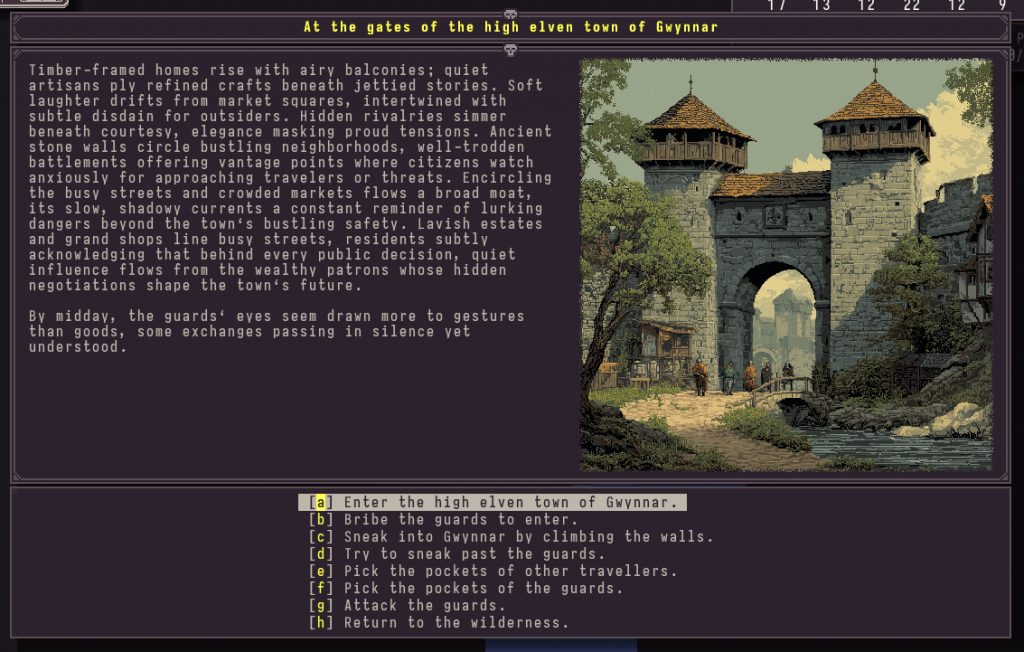
Entering settlements
Work on this feature continues. Still not completed but evolving and lots of general framework features come out of this that will speed up the process a lot for other encounters in the game:
Miscellaneous minor changes and additions
Tooltips now show up after a short delay. This feels a lot more natural. Also delays can be individualized per tooltip type (e.g. button explanations might show up after 500-1.000ms while map tooltips explaining map features already show up after 300ms).
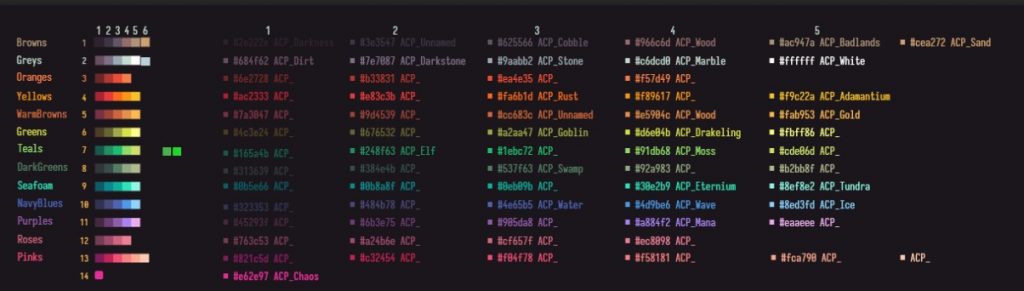
Internal color handling has been refactored. The number of color definitions we used started getting out of hand. About 50% have been scrapped and the naming now is a lot more consistent. This is somewhat important to (some) players because it is possible to change the color scheme(s) by modifying an external configuration file.
Total size of the codebase after this week
39,595 LOC in 655 files for the actual Realms of Ancardia game
28,656 LOC in 460 files in my own underlying TBRLAPI framework library supporting my most recent roguelike games
plus extra external configuration files, images, tilemaps, audio files, etc.
We use YouTrack to manage ideas and bugs that pop up. The listings are by no means complete – it’s more of a “don’t eventually forget to fix this bug / add that amazing feature” pipeline that gives a little structure to our development process without turning it into a managed project 😉
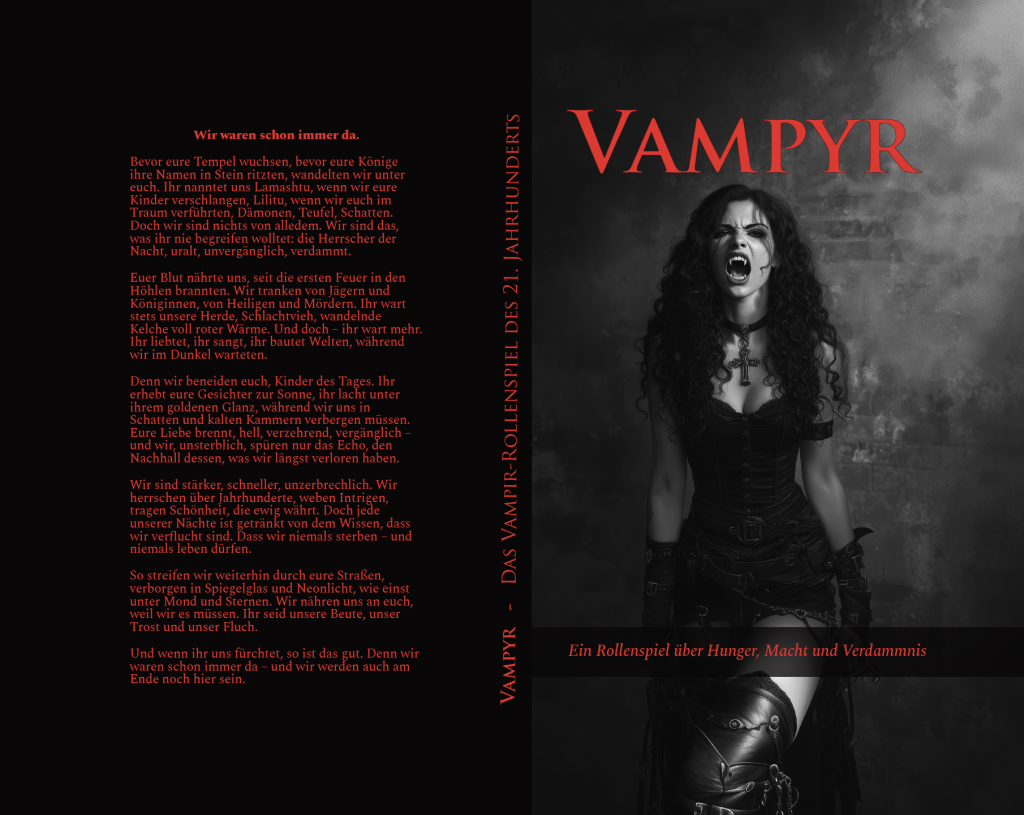
Vacation time is over (sadly) which means that we return full throttle to working on Realms of Ancardia. I needed a day or two to remember all the things I forgot during the past couple weeks (so much for my literate codind skills 😉 and I again was sidetracked by weird mini project I felt compelled to complete (after getting addicted to the Vampire Diaries I felt the need to write my own vampire TTTRP – 104 pages later it’s no at Lulu for layout 🙂 ).
If you care here’s front and back of the rulebook containing 104 pages in novella format with compact rules for nice Vampyr sessions…
Now I am finally looking forward to adding actual fun gameplay to Realms of Ancardia – pardon the distractions 😉
Message log and command popup added
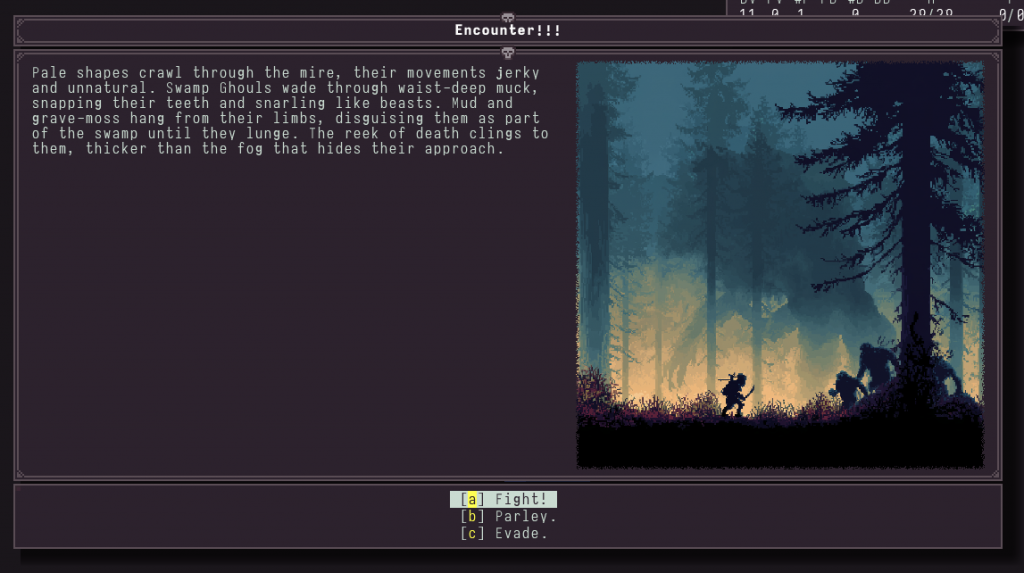
We have replaced the continuous message log to the lower right with a context specific popup. We feel that the extra “pop” is a good change to indicate that something important is going on compared to long text logs where it is easy to lose sight of important status changes. What do you think?
Also we now have a popup that shows commands that are available depending on the current context:
Implementation of settlement gate procedure started
Entering a settlement is a small detail – but it has many intricacies. Depending on the organization of the settlement there might be (guarded) gates, guards might raise taxes, random events could occur, you might gather helpful information about the settlement before actually starting to move through it (which can be useful – some settlements might be very dangerous or could affect your health, sanity or whatever).
This week I started the implementation of the procedure for entering a settlement but I probably will need another week to finish it due to the amount of detail to be covered and some lose ends from earlier weeks (e.g. attributing precise number of guards to the individual gates) in order to present a tangible challenge at the gate.
Here we go with a preliminary screenshot – the UI still needs some polish:
Scene graph implementation
Realms of Ancardia uses content-based scene graphs. Note that this is different from the common understanding of scenes and scene graphs in many programming languages where these termins describe graphical nodes and the graphical composition of a view.
In Realms of Ancardia a scene graph is a logical content structure that describe how a specific scene might work out.
Scenes can be highly variable:
entering a settlement
visiting a shop
talking to a stranger
examining a weird altar in a dungeon
etc.
Logically Realms of Ancardia uses a graph of connected scenes. Scenes can lead into each other (e.g. the generic Gate of Settlement scene might lead into the Negotiate Taxes with the Guards scene or the Pick a Fight scene or … whatever).
Scenes have graphical elements (e.g. images or videos to make them more tangible), text elements (e.g. the impression of a city you get when moving towards its gate) and interactive elements (how you respond to the scene).
This week I finished both the implementation of the architecture and the data structure for these scenes as well as of the graphical scene handler that takes an arbitrary scene graph and navigates the player through it, altering the game state, executing consequences, etc.
The screenshot above already is using the scene graph mechanism underneath.
Portraits
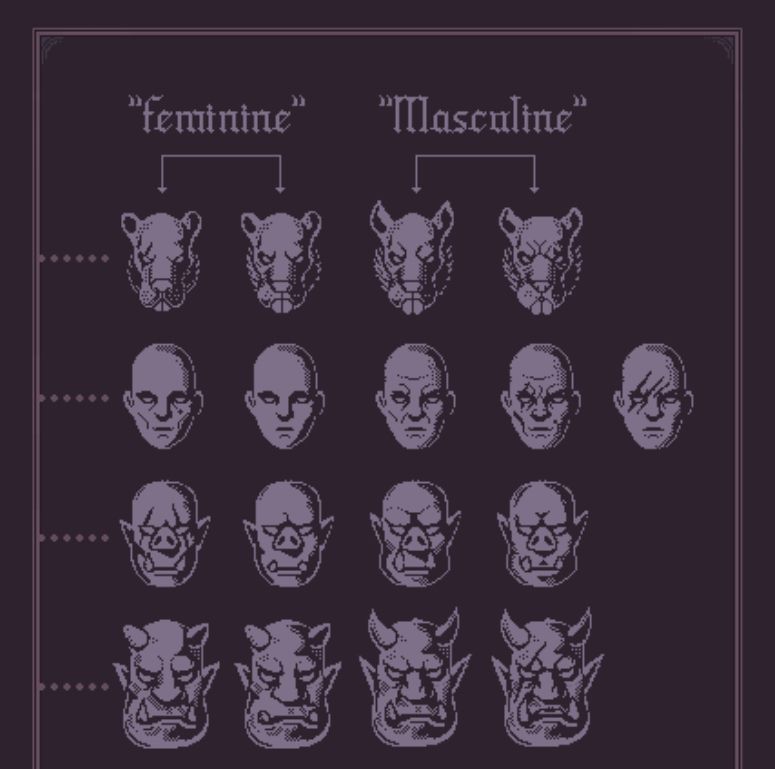
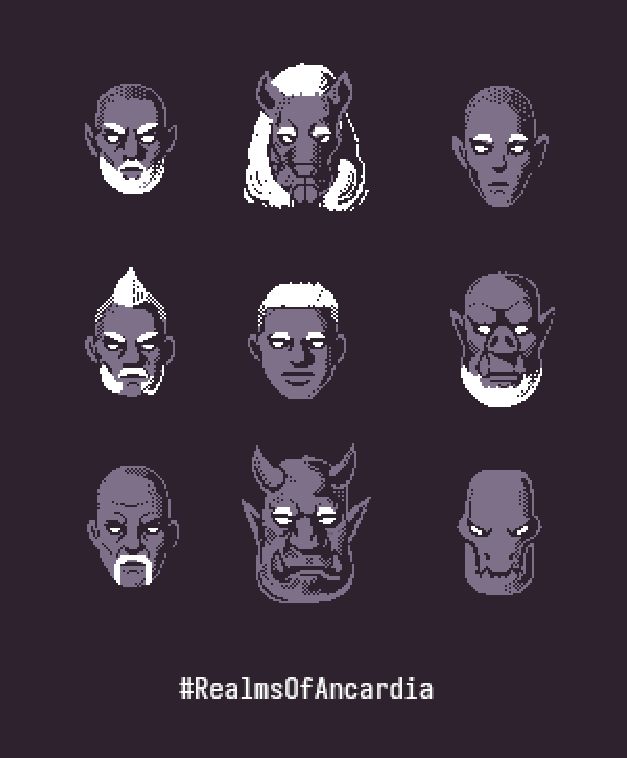
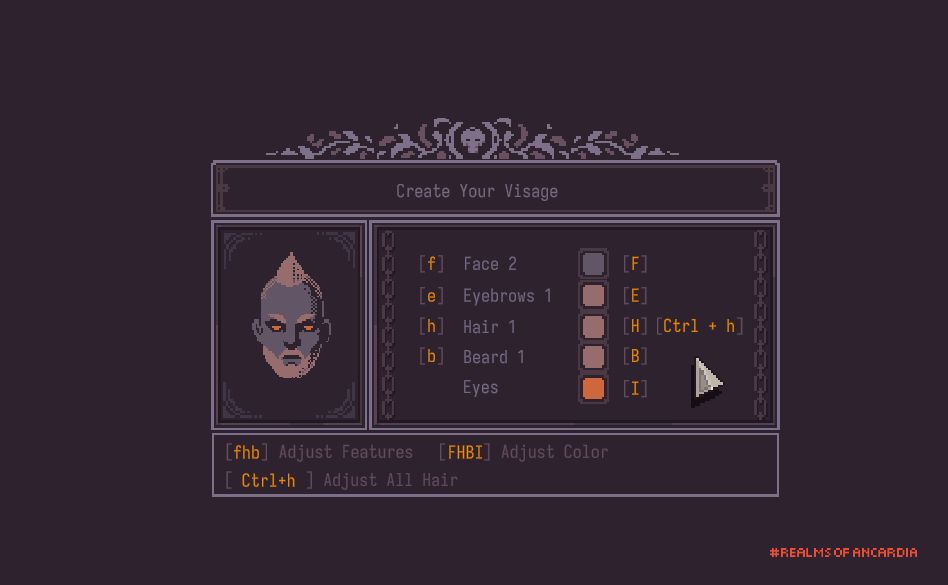
Krys did an amazing amount of working on devising a system for building individual portraits:
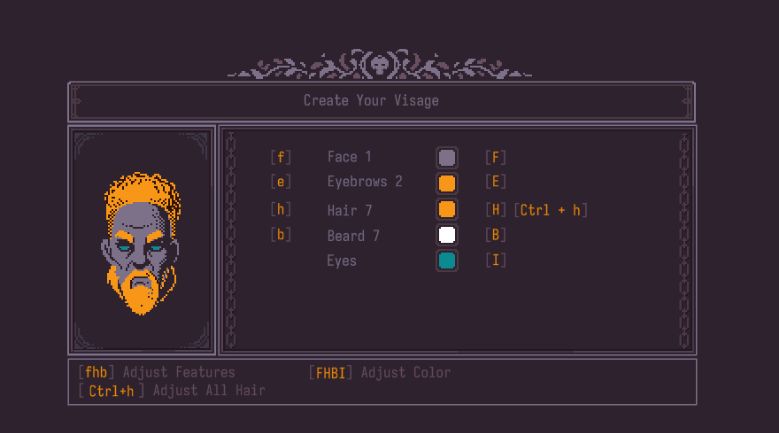
The individual parts are configurable and you can colorize each element:
Miscellaneous minor changes and additions
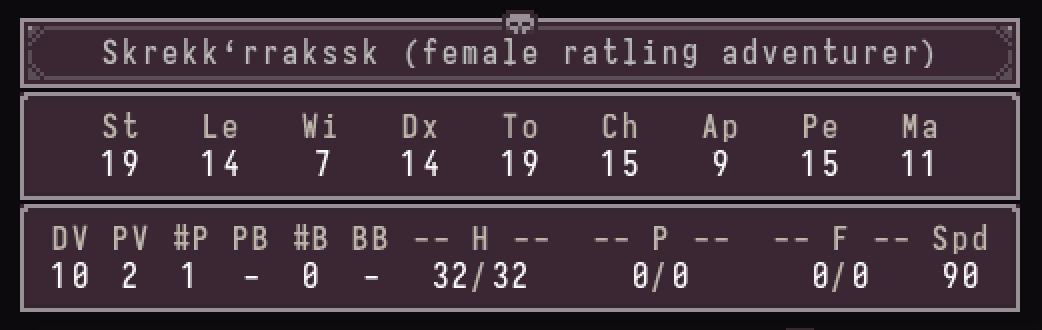
The spacing for the in-game stats has been adjusted slightly to use the available white space more reasonably:
Internal mechanisms for adding missing translations have been improved.
Fixed an integer overflow bug in internal random number generation.
Total size of the codebase after this week
39,413 LOC in 651 files for the actual Realms of Ancardia game
27,357 LOC in 451 files in my own underlying TBRLAPI framework library supporting my most recent roguelike games
plus extra external configuration files, images, tilemaps, audio files, etc.
We use YouTrack to manage ideas and bugs that pop up. The listings are by no means complete – it’s more of a “don’t eventually forget to fix this bug / add that amazing feature” pipeline that gives a little structure to our development process without turning it into a managed project 😉
Since it’s vacation time only some little stuff got done. Also I was a bit distracted by working on my TTRPG “Mythen & Monster” which we tend to play every couple of months. 278 pages of player handbook are finished so far, about 50 more to go. And I started my fifth (or sixth or seventh?) attempt at writing a Gamma World TTRP clone suited to my tastes… but all that’s leisurely passtime during vacations and soon Realms of Ancardia will be back to full speed 🙂 After the next brief interrupt of about 10 days… expect development update around the 27th of August when holiday season “finally” is over 😉
Screenshot functionality added
You now can take screenshots from within the game:
F10 takes a screenshot of the whole screen.
Shift + F10 takes a screenshot without controls and tooltips.
Screenshots are saved as a PNG to the desktop for easy consumption.
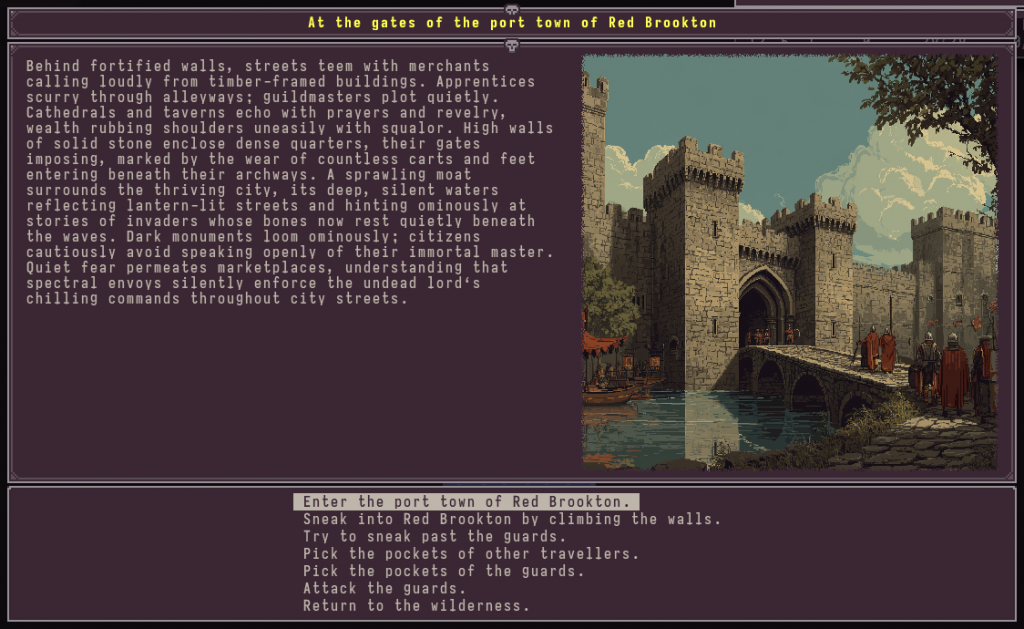
Improved texts for settlements
Work on actual gameplay has started. First thing was to rework the endlessly long texts for settlements we had so far to install a “gate routine”. When you encounter a settlement there are basically two options depending on wether a settlement is walled or not.
If it is not walled you just can enter and might encounter guards or a lonely sheriff while wandering around. Easy times.
If it is walled you can try to sneak in (success will depend on your skills, alertness of the guards, moats and many other factors) or use the official entry via a gate. At the gate you might have random encounters, hear rumors and be tithed.
Tithes are an interesting thing… because they can bery very variable. Lawful/good settlements, free cities etc. just might let you in without any barrier. Merchant-rules cities, feudal settlements and others might demand a small monetary tithe but other governments might be VERY different. E.g. dreamocracies might demand one of your dreams (e.g. some experience points), undead necromancers might request a bit of your life force and religiously ruled settlements an oath of fealty or sacrifices to their religions (with all kinds of potential alignment implications).
Which leads to…
Random tithe generation system implemented
The highly variable nature of tithes has been implemented in form of a small procedural generator that takes settlement size, alignment, dominant population and form of government and derives the type and height of tithe that might be requested at the gates. Joyful times… now you can be taxed in a roguelike 🙂 And new enemy unlocked: The Ancardian Tax Office 🙂
Miscellaneous minor changes and additions
The background color of the game screen now is manually configurable.
Total size of the codebase after this week
38,503 LOC in 634 files for the actual Realms of Ancardia game
27,005 LOC in 447 files in my own underlying TBRLAPI framework library supporting my most recent roguelike games
plus extra external configuration files, images, tilemaps, audio files, etc.
We use YouTrack to manage ideas and bugs that pop up. The listings are by no means complete – it’s more of a “don’t eventually forget to fix this bug / add that amazing feature” pipeline that gives a little structure to our development process without turning it into a managed project 😉
Back from vacation #1 (of 2) during this summer vacation season. As our flight back from the Seychelles door to door took about 32.5 hours (instead of the planned) and was accompanied by tons of stress due to total incompetence and stupidity of both Etihad and Abu Dhabi airport management we are still recovering. Work on Realms of Ancardia thus restarted more slowly than I had hoped. Still some stuff got done.
Map memory implemented
Before we could start working on actual combat and encounters we finally had to clean up some areas yet untouched. Combat eventually will require nice animations for attack, damage, etc. Before we can implement those we need to cement the architecture of how knowledge about the environment is retained. An important aspect of that is map memory (e.g. what does the player character remember of map areas he currently can’t see).
This is functionality that needs to be contained in the underlying TBRLAPI (my generic framework for all current and future roguelike games I build). Therefor I had to implement map memory and I needed a map memory that was meant to allow variants (e.g. total map knowledge all the time versus limited/growing map knowledge).
There the first thing added this week was a map memory management infrastructure.
Line of sight implemented
After implementing map memory the next important step was to finally add a “line of sight” architecture that allows for various use cases:
You can see everything.
You can see for a certain distance and map elements can block sight or not (the binary simple case).
You can see for a certain distance and map elements have different levels of sight blockage (e.g. plains barely block sight range, forest and hills quite a bit, mountains a lot depending on height).
All three use cases have been implemented and for now Realms of Ancardia useses the binary use case. But this will change soon to have more differentiated sight cases.
Here’s a brief video of the current unpolished state:
Cheat mode implemented
As the game becomes more and more complex we a more and more in need of a cheat mode to speed things up during testing. Therefor we implemented a cheat mode this week. It’s actually ported over from Ultimate ADOM and consists of a neat command line interface with smart auto-completion that can be infinitely extended with commands.
Here’s a brief video showing the initial version (more meaningful commands soon to come):
Tile style experiments
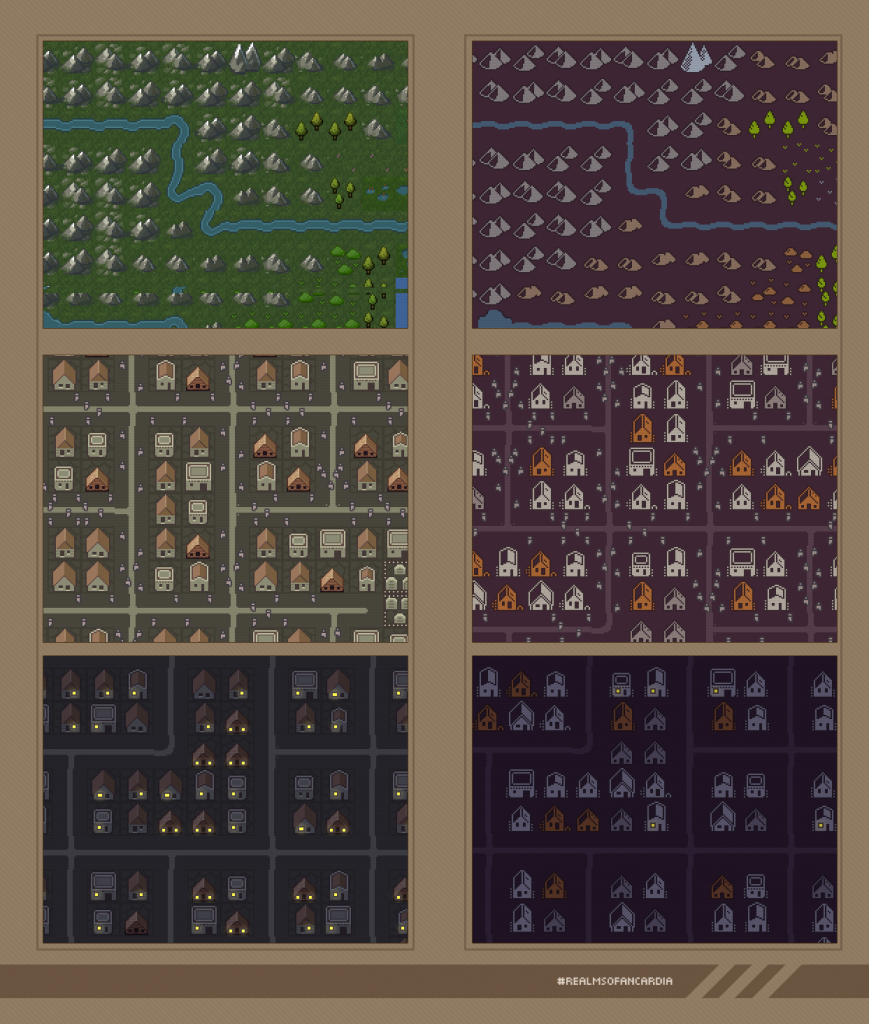
We wrestled with the question of how to evolve our art style for the tiles. After quite a few discussions (also on Reddit) we decided to go with our current art style (right side) and evolve it – it seems to be more distinct and also seems to create more emotions in people with its raw old school power:
3D Globe for the world map
We added a 3D viualization for the surface world map. While we love the style we sadly had to discover that using it causes motion sickness and headaches – therefor we will put it on the backburner for now, work on improvements and hopefully eventually integrate it into the game as a permanent feature.
Here’s a brief demo:
Miscellaneous minor changes and additions
A bug in the player movement code was fixed that caused weird player sprite flickering during movement.
The RoA engine now has nicer error handling when mappings are missing for tiles (which happens quite often these days when we add dozens of new beings, items, …). The engine now not only complains about problems with an exception but the exception also directly contains template code with sensible default mappings that I can copy over with one simple copy & paste operation so that adding stuff is more easy than ever.
Various optimizations and bug fixed have been added.
Total size of the codebase after this week
37,574 LOC in 629 files for the actual Realms of Ancardia game
26,947 LOC in 447 files in my own underlying TBRLAPI framework library supporting my most recent roguelike games
plus extra external configuration files, images, tilemaps, audio files, etc.
We use YouTrack to manage ideas and bugs that pop up. The listings are by no means complete – it’s more of a “don’t eventually forget to fix this bug / add that amazing feature” pipeline that gives a little structure to our development process without turning it into a managed project 😉
During our Seychelles vacation in the second half of July 2025 one morning I woke up with the idea for a new roguelike game: BlobRL. All information currently available has been collected on this page.
This update is one day early – simply because tomorrow is Creator’s Day and on Creator’s Day there shall be no work 😉
This week saw major architectural changes. It started off with deleting lots of code I had created during the past weeks (and during several months when I started a first draft of this game a couple of years ago). This brings the one major change in week 6:
Curses foundation removed
When I originally started to work on Realms of Ancardia I had planned to create an ASCII-only game. Because it was meant to be a great passtime for me, I have no graphical talent, I had no artist available to help me (nor the resources to hire one) and I just wanted to move as fast as possible. And nothing beats ASCII-based graphics in that regard.
A couple of years passed, the project lingered and was almost forgotten and my good friend Krys was available and willing to enter the project.
Suddenly there was the option to find a unique yet old-school graphical representation for the game, taking all our learnings from working on ADOM and Ultimate ADOM and trying to do something even better.
And here we are working on a (hopefully) wonderful game with awesome old-school pixel graphics.
Therefore piece by piece the initial Curses implementation became more and more useless. As I already had implemented a new lean UI component architecture in order to show tooltips the decision has been made to extend this to cover all graphical aspects of the game.
Thus this week I ripped out my Curses implementation and replaced it step by step with my graphical component framework. Since the initial framework was designed to always use Curses this required quite a bit of fiddling. On the other hand it helps resolve a lot of weird ideosyncracies that had popped up when mixing the Curses implementation with the new graphical component framework.
This resulted in ripping out code, deleting unused stuff and more. But it makes the game cleaner and leaner which is great because I really try very had to fight technical debt as early as possible (having learned from ADOM what it means if you hit technical debt that has its origin in weird decisions that are 20 years old).
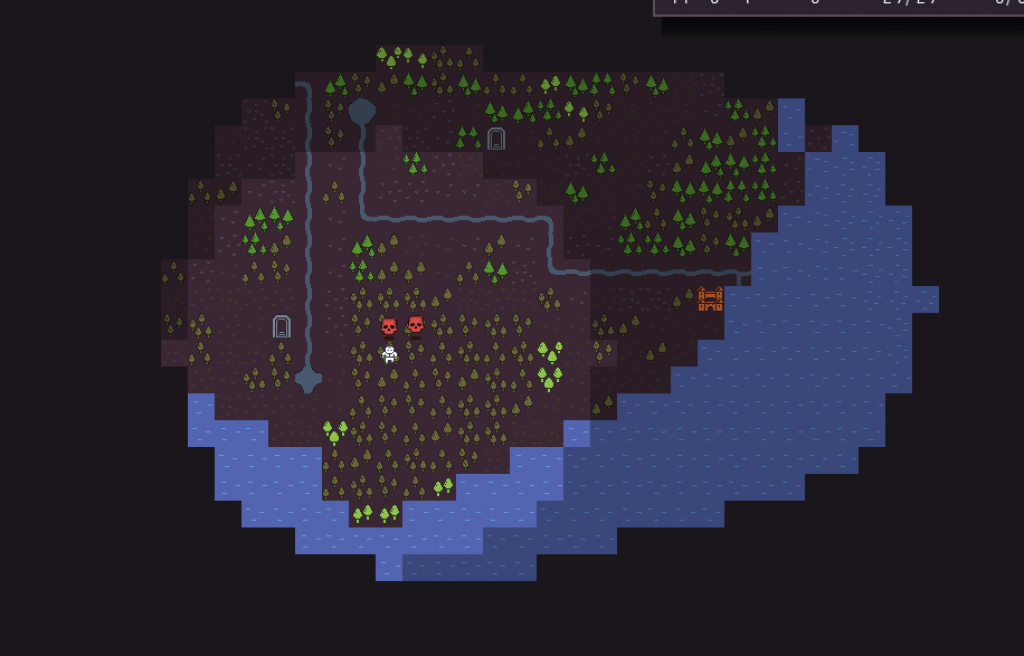
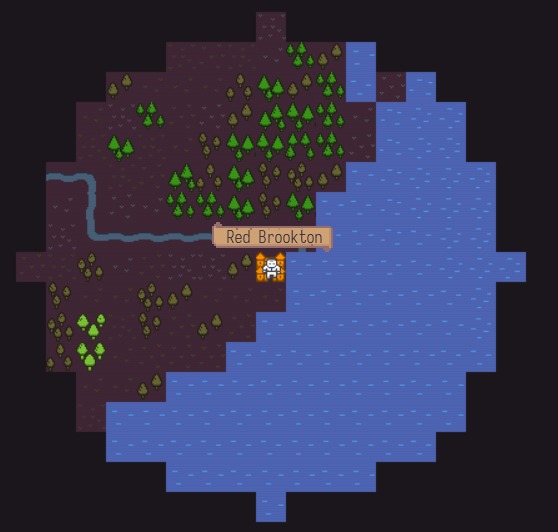
The result is this new look for the map screens where the changes are most notable. Naturally we will evolve the UI a lot over the next months as things grow:
Note that the ugly text are to the lower right will disappear. It’s just there due to the straight port but needs to be changed.
Miscellaneous minor changes and additions
There are now extensive mappings of talent category priorities to resulting professions.
The game window now has a decent title.
The game window now shows the number of frames per second. At some future point this will be disabled (or configurable) but for now during early development it’s an important indicator for our engine performance.
The full screen mode works again. It broke at some point during the past couple of weeks and fixing it required some refactoring but not it’s finer than ever.
Total size of the codebase after this week
34,006 LOC in 593 files for the actual Realms of Ancardia game
23,552 LOC in 399 files in my own underlying TBRLAPI framework library supporting my most recent roguelike games
plus extra external configuration files, images, tilemaps, audio files, etc.
Lots of graphical details have been added in week 5. And work on character generation continues. It starts to feel like something almost complete. Overall the graphical fidelity has gone up another notch (while retaining the old school charm we are aiming for) and this will drive more changes in the weeks to come.
Also lots of infrastructure work happened in the background for the underlying game sytem as you can see at the end of this post by more than 160 new classes in the game alone (and “only” about 6,200 new lines of code… infrastructure often is not very complex per component but usually needs a lot of components to be extendable and efficient enough).
Animated main title image
Krys outdid himself animating our so far static main title image. We now have a beautifully animated title image:
Graphical frames
Dialogs, windows and tooltips now can have graphical frames in order to make them visually stand out more cleanly and be more attractive.
Here are is one example, more below with the other new features:
Visual upgrade for character generation
Everything was overhauled:
Typography
Spacing
Framing
Unified color scheme
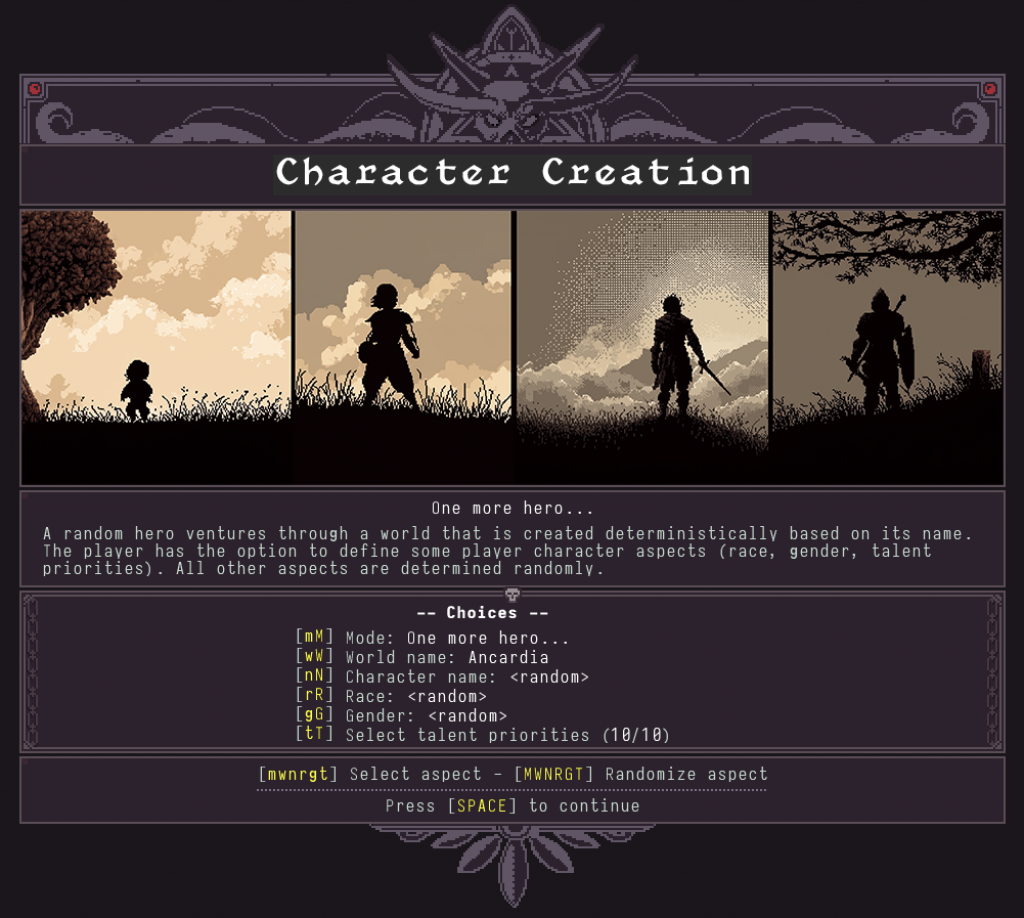
All in all character generation (considering its basic state) now is looking a lot more pleasing and still fully aligned with our planned old school charme. Here are updated screenshots – compare them to last week if you like to see the progress:
The central character generation screen – from here you control everything
Definining talent category priorities – this basically shapes your former professional life
Selecting a race
The gender selection step already was shown in the previous section and skill selection still needs to be implemented (although most of skill infrastructure already is there).
Death screen added
Death always has been a big part of ADOM and it also will be a big part of Realms of Ancardia – even though the default game will have a wonderful twist by introducing permalife instead of permadeath. More on this at some later point in time… here’s the default death screen for your final death…
Item architecture created
It’s time to get items into the game in order to finish character generation. This usually requires a lot of infrastructure for a game with the complexity of Realms of Ancardia. So this week I did a lot of tedious groundwork by implementing these concepts:
items data structures
item templates
item template generators
item containers
item types
base items
template based items
item modifiers
item traits (that cause modifies to become real)
infrastructure for implementing random items based on some base template
infrastructure to randomly generate items based on type and desired power level
Not much fun but they enable one of the major fun parts – creating cool items 🙂
Also statistics now adjust due to equipping or unequipping items, etc.
Rules and architecture for initial equipment
Realms of Ancardia uses a system based on race and initial talent category levels in order to define the starting equipment of the player character. Both the architecture for this approach plus all rules to generate starting equipment based on on 12 races, 10 talent categories and 6 talent category levels for a total of
12 x 106 = 12,000,000 starting combinations for equipment
have been implemented. And since some of the starting equipment is randomized there is an almost infinite number of setups.
More details will be added to this system later when we implement star signs, background stories, feats, etc.
Started adding item templates
Adding items will be a forever job considering that ADOM had hundreds of them. To get character generation started we added 92 base item templates in 18 type categories. More to come – even character generation is not yet fully complete (we need a lot more scrolls, rings, wands and potions).
Inventory / information screen prototyped
I started with a prototype for an information screen about all data that makes up the player character (bound to the classical “i” for inventory – but it’s a lot more than that – so “information” seems to be the better future mnemonic for this).
Here is the unstyled prototype mostly used right now to confirm that data goes where it should while building a character (Krys already has prepared nice tab images but I was too slow to implement them before the weekly update had to go out):
Just some of the basics for now on the stats screen…
A basic inventory – all the item details still are missing…
And the backpack… again all details are missing and we probably will add category filters and… and…
The skill tab has not yet been built and the tabs themselves need to be upgraded visually.
Basics of a tavern generation system implemented
Taverns play a big role in any classical fantasy setting, even more so in Realms of Ancardia with its large number of highly variable settlements. Creative struck me like lighting and I designed a tavern generation system which provides the following features:
race-specific tavern names (e.g. dwarven taverns should be very differently named from dark elven or orc taverns)
randomized potential tavern activities (from standard stuff like dining and drinking to much more elaborate stuff like pitfighting or quest access)
room types and prices depending on the specific settlement data (and some randomness)
randomized rumors you might be able to hear while staying in the tavern
randomized special events (like a bar fight or the chance of your pockets being picked)
randomized special traits for taverns (like being haunted, a smuggler’s den or fey touched)
All this should help to make taverns truly unique places that are exciting and useful (and also sometimes dangerous) to visit. Besides all the avdenturing opportunities you can rest and recover in taverns and learn more about the settlement and the world.
Calendar component added to screen
The Ancardian calendar always played a prominent role in ADOM with it’s star signs and stuff. So it will in Realms of Ancardia, maybe even more so, now that we have complete civilizations, compex government forms and a whole world to be affected by the stars…
For now the map now is graced with a beautiful calendar widget that shows the time of the day (and in coming weeks will be enhanced with a star sign display). Here is a sample screenshot:
Day and night are important… especially in settlements
Note that this calendar version is just a first draft. We are right now working on an improved design where the surface world map will show a calendar focussing on the star signs (due to the extended movement time frame on the surface world) while the settlement maps will show the day and night cycle (because that really makes a difference in the settlements).
Miscellaneous minor changes and additions
Krys added a cool font to be used for headlines.
Kry generally spent time improving our fonts and typography.
Krys started to work on star signs.
Added a tab component to our UI framework.
Added a video component to our UI framework. And will have more of them in the future (think of small animated sequences like e.g. tavern images, etc. – a little like in my beloved Bard’s Tale I-III and Wasteland). Just a tiny bit of movement and animation – but enough to be fun.
Windows now have shadows.
Total size of the codebase after this week
34,385 LOC in 603 files for the actual Realms of Ancardia game
22,761 LOC in 383 files in my own underlying TBRLAPI framework library supporting my most recent roguelike games
plus extra external configuration files, images, tilemaps, audio files, etc.
Some weeks are great, some less so. Week 4 was a bit sluggish and annoying due to a large number of bugs suddenly plaguing development. But most were slain. Hooray!
Bugs, bugs, bugs
No idea where they came from but I lost a lot of time (well, at least for some of them) getting them under control:
In week 3 one of my optimizations introduced a memory leak that took me 3/4s of a day to fix.
My underlying TBRLAPI originally was designed for games based on the Curses API (well, my re-implementation of it). Realms of Ancardia is more and more moving away from the initial Curses-based approach towards a purely graphical implementation. This caused some friction with rendering and update issues. The underlying architecture of TBRLAPI still puts the Curses-approach too much into the forefront and the less it is needed the more I feel I have to introduce workarounds to get my Curses approach out of the way. I do not yet have a good idea on how to fix the architecture but something needs to happen since a number of update and rendering bugs this week were caused by the unholy combination of the formerly dominant Curses approach and the now evolving pure tile based and graphical approach. Birth pains of an API…
A Rider update wrecked my gut behavior. And while I love version control (and am fine with git generally) I really think that the git command line interface is one of the worst designs ever. Arcane, full of weird special cases (at least it feels to me like that), etc. It probably all makes sense if you manage a project with the size of the Linux kernel but I still feel that the git interface is just lousy for the majority of software development projects it is being used in. The wrong system won the VCS war in my book. Or at least someone should have taken the time to make git a lot more understandable for 95% of the cases. I lost half a day getting git to forget about files it suddenly started tracking and I still don’t know why this happened. What a lousy way to spend time…
There were some rendering issues where “dirt” is cached somewhere.
Character generation started
It finally feels like the game needs some flesh. So we need to start generating an actual character. I have started working on a primitive character generation screen which will be beautified once the various components of character generation are stable enough. For now it is ugly as hell. But it’s there.
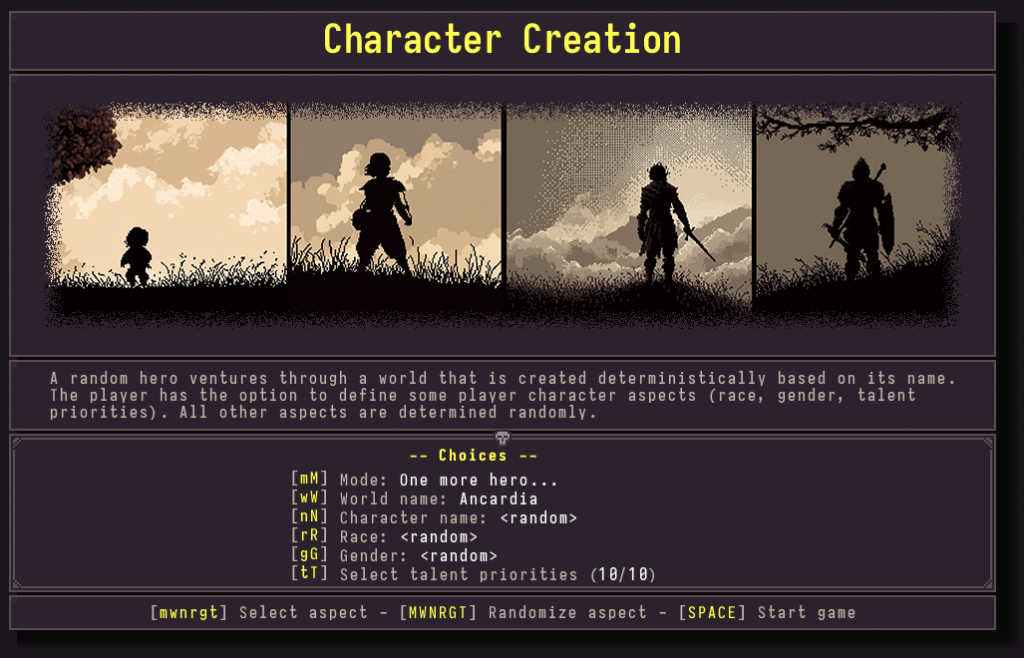
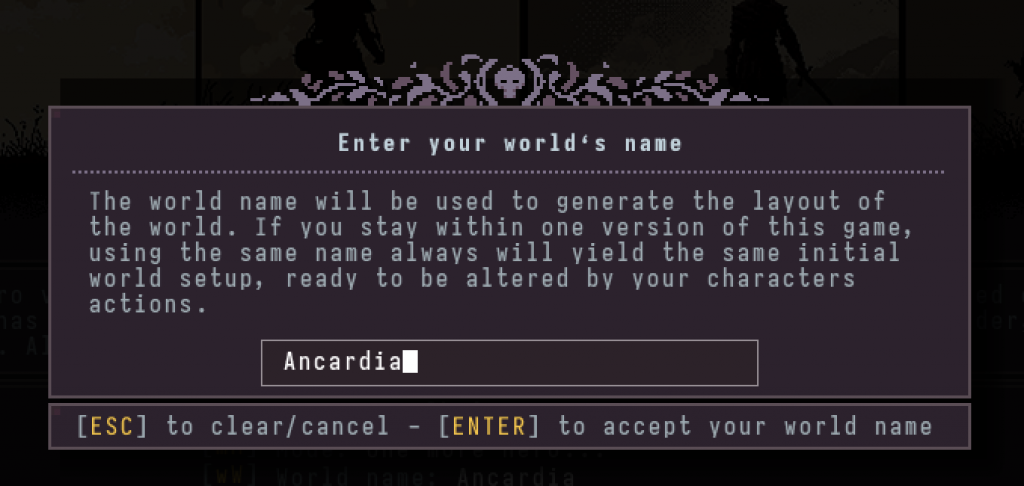
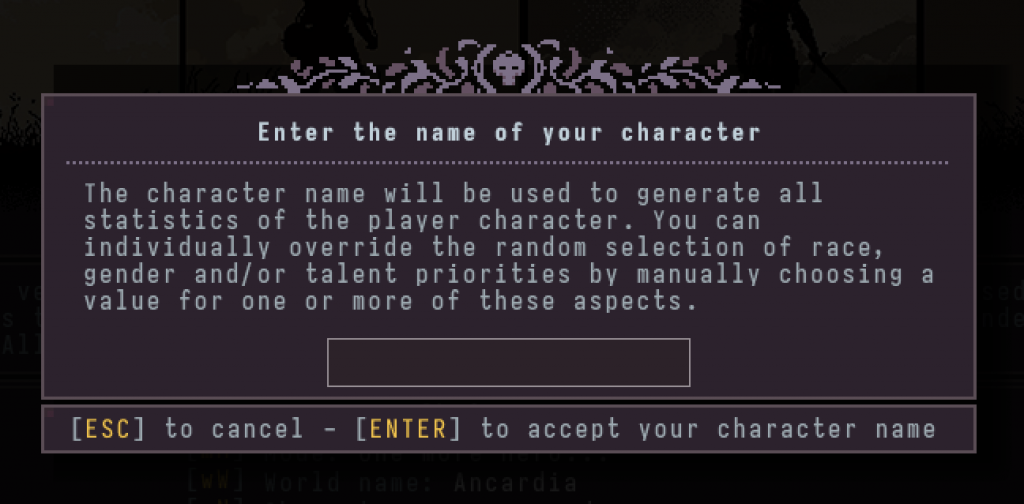
On the main screen you can select the general generation mode (totally random or based on the name of the world and the character are the only two options righr now but a lot more will follow), generate a random world name (later you will be able to enter it yourself but we do not yet have code for text input), a character name (same challenge, but if you have selected a race and a gender then the internal race- and gender-specific name generators are utilized), select race and gender and prioritize talent categories.
The latter is the first major deviation from ADOM: Where in ADOM you have a ton of classes in Realms of Ancardia you can give different priorities to ten areas of expertise (see below for more details).
Each category has up to five levels of expertise (plus “untrained”). If you have at least some expertise you gain attribute bonusses during character generation, skill costs change (for the better the more excpertise you have) and you eventually will get other benefits (like free feats or special abilities).
We also are going to add back the professions from ADOM although they will have somewhat different rules and basically just are prioritized talent category sets. So in the end they will be useful to speed up character generation but you also have the option to kind of “cook” your own profession.
Here are some screenshots from the current state (most beautification still is missing… we just want to get ground by adding content on our race to an alpha release in… months… years… who knows 😉 ):
The main character generation screen so far (work in progress)
The ancestry selection screen
The gender selection screen
The talent priority selection screen
There is still a lot of work to be done but this IMHO is starting to look decent in a certain old school way I really enjoy.
Talent category system
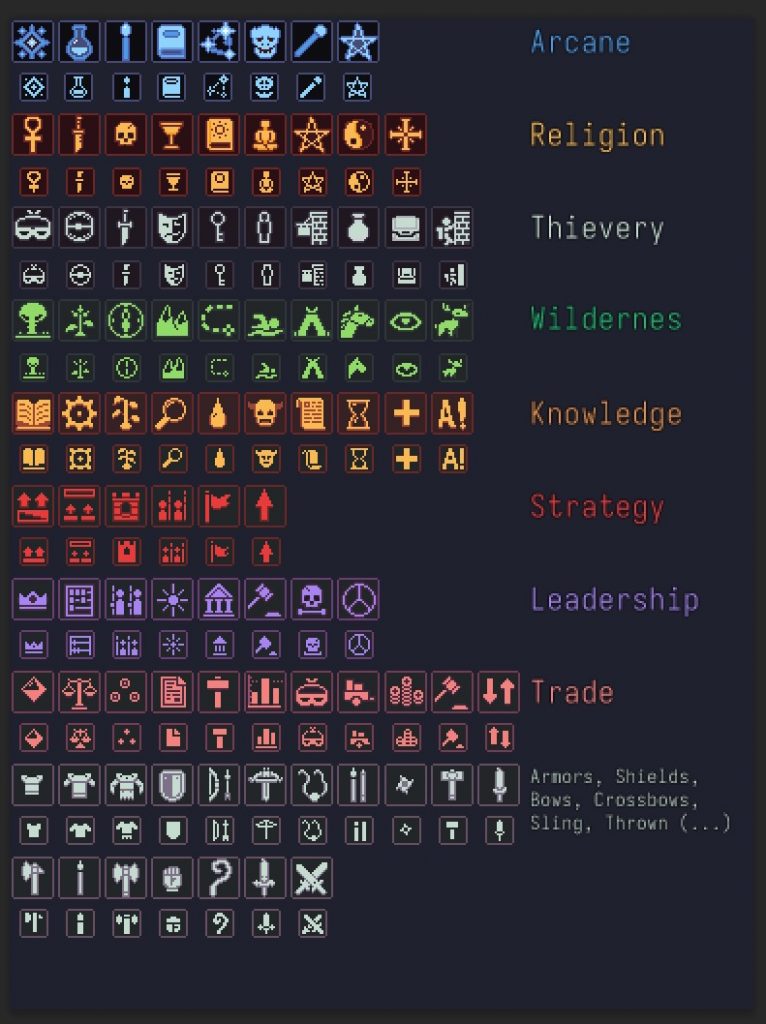
I have implemented the talent category system. The following ten talent categories exist (taken from the source code):
The general scope is much wider than in ADOM because eventually Realms of Ancardia will allow for a lot of activities besides dungeon crawling and monster killing – like building trade empires, raising armies and more.
Skill system
An initial draft for the skill system has been implemented (but the individual skill functionalities are going to be added over time). Here is the skill list from the source code together with the attributed talent categories (see above):
Skills are ranked and run from 0+ to 40 and more. Usually they will be in the 0-20 range for normal adventures and might rise above 20 for experienced or highly specialized characters. The following abstract ranks are used (again taken from the source):
I revised the name generators to create a lot more ADOM-like names. I’m a lot happier with the results and now tens of thousands of beings can have unique names.
I added special algorithms for shopkeeper names, ratling trader names and dragon names.
I added dragon personalities tried to unique dragon titles for special dragons.
Added faith points as a new attribute. While ADOM used power points for priests and wizards, Realms of Ancardia will differentiate between power points (used for arcane magic) and faith points (used for miracles).
Renamed talents to feats.
We debugged an annoying memory leak.
Krys enhanced many tiles making them subtly more beautiful and also added more monster tiles.
Some bugs were fixed related to combat and actions.
Total size of the codebase after this week
28,022 LOC in 440 files for the actual Realms of Ancardia game
21,635 LOC in 369 files in my own underlying TBRLAPI framework library supporting my most recent roguelike games
plus extra external configuration files, images, tilemaps, audio files, etc.
Week 3 was a bit slow because I was away with family & friends on a five day vacation trip to the wonderful isle of Borkum. I’m still happy with the progress I managed. All in all Realms of Ancardia is shaping up nicely, considering that we probably need at least 12-18 more months for an early alpha release. Let’s look at what was accomplished.
My personal goal for week 3 was to work on the graphics framework of the game and introduce lots of new UI elements plus a dynamic layout composition system for UI elements. But before I could tackle that I had to clean up issues left unsolved during week 2:
Refactoring of movement system finished
I failed to finish the (un)planned refactoring of the movement system during week 2 and thus had to continue working on this. Major subsystems now have been fixed or integrated:
There are now time-based actor lists that control who acts when. And what happens on the sidelines.
There is now a standard way for switching maps back and forth including PC positioning.
The internal main loop has been greatly simplified.
The way to calculate time spent has been standardized.
The movement system has been fully standardized.
About 50+ bugs related to his system created in week 2 have been fixed.
UI component set implemented
Currently we still use an underlying Curses implementation of my own for the text on the screen. Eventually I want to be able to use a smart configurable component library to place elements as needed. This week I implemented the framework for a library that allows various layout managers, nested elements and scaling. Neato!
At this point I really feel happy with the decision to use MonoGame as the foundation for my framework. It is stable, clean and has few areas of weirdness (keyboard handling being one – but we’ll see about that later). And so far it seems to be extremely efficient for rendering which makes me very happy,
Also the APIs are elegant to use. All around bliss and for me a much better experience than with Unity or GameMaker (although GameMaker had a certain charm – but in the end it was a convoluted puzzle box with strange bugs… so I will continue to please my NIH syndrome and move forward building my own game engine 😉 ).
Option selection UI added
Already now the player is faced with options (although peculiar due to testing purposes – like “which group of commoners in a settlement should I attack?”). So far we had no UI for this. During this week I added a nice component framework setup (see above) and a dialog for option selection was the first use case.
I am quite happy with the results (although we still need to work on visual decorations). This is the code sample:
The code above creates this kind of dialog on the screen:
Obviously this needs a lot of graphical sugar and we already have ideas we want to explore. The following is a very early sample design and once Krys and I finalize the actual UI design I’ll integrate the design into the code:
(please ignore the typos – rapid prototyping here 😉 )
Tooltips
I have implemented the basic framework for tooltips. Tooltips will get lots of more detail and visual enhancements over the next weeks and months but now there is a rock solid foundation that allows arbitrarily complex and detailed tooltips. This will help us make the game a lot more accessible than ADOM ever was.
Here is a sample screenshot of a (yet unstyled demo) tooltip:
After week 1 went really well the focus of week 2 was to get an initial encounter and encounter battle map up and working. While doing that I tried to finish many loose ends in the Realms of Ancardia engine.
Encounter handling implemented
While I’m probably going to add tons of stuffs during further development a pretty strong combat encounter framework is now in place and work. Let me explain with our first example: Because I had lots of fun during the setup of the system to toy with our settlement generation system (which we needed because the surface world in the game is huge and contains hundreds of settlements ranging from small hamlets to huge metropolisses (is that a word?)) I decided that the first test case for a combat encounter would be attacking citizens (because why not – nobody said that Realms of Ancardia is against game for heroes only 😉 )
To be able to attack citizens the following things were on my implementation plan:
Citizen encounters needed to be variable. For that I set up a so-called ReactiveEncounter on each street tile. Reactive encounters are activated as soon as the player character enters the given position. My SettlementInhabitantsEncounter has the sole task to monitor the flow of citizens (selecting crowd volumne and a dependent number of random settlement encounters chosen from a large table [well, the table will be eventually large, right now there is exactly one entry – an encounter with simple commoners]). CHECK. The SettlementInhabitantsEncounter also was finished last week. Now the fun started.
I had to set up an actual encounter:
Encounters in Realm of Ancardia are modal (while e.g. in ADOM you only could encounter single monsters per tile). An encounter in RoA can be anything from a single monster, a trap, a text, a feeling or an army lying in ambush (and everything in between).
An encounter needed a way to define beings and the options it entails.
The encounter with commoners is a passive encounter (meaning: the citizens ignore you unless you interact with them). So I needed to implement an encounter lifecycle (which now has four stages for four basic types of encounters). Passive encounters are phase four (phase 1 are reactive encounters, phase 2 are combat encounters, phase 3 are active encounters [that activate automatically] and phase 4 are passive encounters).
I also added that failing to solve an encounter in phase x can stop you from reaching encounters in phase (x + 1). So if e.g. there is a treasure encounter that is guarded by a dragon combat encounter you won’t be able to reach the treasure until you solve the dragon combat encounter (which most often probably means killing your opposition).
If you encounter e.g. 8 commoners, attack them and kill 3 of them – what happens to the rest (answer: I implemented an encounter state management that keeps a tally of the opposition).
Initiating encounters can have recriminations. E.g. attacking commoners in the city will flag you for committing a crime (Assault).
Here new ideas spawned:
First of all I needed an API to add reactions and workflows to encounters. The basic framework now is there and as first examples I implemented OnDeath and OnAttack handlers.
Now that crimes were accounted for (affecting your reputation and activating the underlying criminal justice system) the unsolved question was: How does the settlement react to crimes?
So I came up with the idea for settlement events that could be posted to the settlement and would propagate from there throughout the settlement (or at least parts of it).
So I added a means for posting settlement events, the first being a CrimeOccurred settlement event.
After that was done I pondered event propagation and for Realms of Ancardia this is rather easy:
There are small settlements with scattered homes. Here I implemented a circular propagation where after each time frame the event spreads further outwards from its origin.
In larger settlements events actually spread following the streets.
It becomes interesting whenever an event reaches a special building (the non-boring buildings in settlements). Special buildings consume these events and react to them. So if e.g. a CrimeOccurred event reaches a CityWatchStation special building, this in return might spawn a city watch patrol that heads for the location of the crime. And eventually reaches it. When it reaches a raging combat encounter the guards actually might join. If you finish the fight before they reach you, they will track you (at least for a while).
Then it dawned on me that there could be more interesting mechanisms than just spreading events:
Realms of Ancardia has 21 government types (some of the more interesting being the Magocracy (being ruled by wizards), NecrocracyCouncil (a group of undead ruling the city), NecrocracyTyrant (a single undead ruler) or Theotechnocracy (being ruled by an actual [demi]god living in that settlement). It would make a lot of sense for these government forms to create different reactions to events:
A magocracy might react by casting spells at you (while you are still fighting in a totally different encounter) to punish you. Maybe with a little delay because they need to agree on a course of action first. And if they take too long they might summon some demons or elementals or blink dogs (depending on their alignment) to hunt you.
An undead tyrant might immediately summon undead from the ground that join the battle (and in general: if the crime is severe enough).
An undead council might summon a lot more undead that a single tyrant – but maybe they again need longer to react because they will have a discussion first.
A (demi)god ruling the settlement might send (un)holy guardians to the battle site… or whisk you away immediately… depending on his domains, power level, etc. If you are particularly dangerous to the settlement the (demi)god might even decide to appear and handle the issue by trying to cause divine massacre.
And so on and so forth. Even the more mundane government forms will have different troups, reaction times and so on and their disposal.
And we are just talking about violent crimes here.
So I implemented a SettlementEventPropagator pattern which depends on the type of goverment of the settlement and implements different strategies to react to events.
But back to the beginning: To attack citizens you need the option to do so. There is no “moving into enemies to initiate attacks” in the normal movement mode of Realms of Ancardia because each position in theory can hold an infinite number of encounters. And you can move through them (usually) for reasons I maybe will explain in some other post (if anyone cares). So I needed a system to offer variable options for interactions to the player (depending on the specific encounters). So I implemented a means for passive encounters to return a list of potential interactions.
Then I needed code to group these interactions (e.g. if there are ten different encounters you might be able to attack this in the first step is consolidated under a single “Attack” interaction and only when you choose that you get the list of ten potential targets to select the right one (and I’m still pondering if starting a fight on a settlement position immediately should draw all beings into that fight).
Interaction options needed lots of details:
Texts (all translated naturally).
Checks to see if they are available NOW (e.g. a ‘c’hat option should not pop up if the player is deaf).
Why BTW prompted a new sidetrek because I had not yet any states (like deaf, asleep, paralyzed, …) to beings.
And when I added state I also needed to add state arithmetics because state (like attribute scores and other data) is accumulated across innate values, equipment, skills, talents and other factors.
I had to add dynamic binding and unbinding of keyboard commands to represent the shortcuts to the interactions.
I needed grouping, sorting and filtering of options.
I had to create a simple initial dialog system to present sublists and select them.
And then this lead to…
Refactored the movement system
And I am still working on it and foresee another day or two of work with this. Previously most movement was faked – now there are the outlines of a complex movement routine which caused me more trouble than expect due to having to cope (depending on map type) either with abstract encounters or specific beings on a map.
C# generics are no little part of the challenges and I will continue to work on the movement system next week. Right now there are still broken code pieces and various bugs. But as they say: TANSTAAFL.
Combat encounter implementation started
This is one of the core components of the future game and as such probably will see fiddling and extensions over years to come while we add more and more detail. The basic idea is that once a combat is initiated you zoom into a combat map defined by the encounter type and environment (e.g. for fights in a settlement a map is derived from the surrounding streets and buildings). The enemies are placed on that map and a turn-based combat ensues.
The basics for this have been implemented although tons of details still are missing (inventory handling, other items, special effects, lots of details for the combat system and so on).
Here’s the video of the very first battle in Realms of Ancardia filmed:
There is a ton of stuff that needs improvement but I’m actually pretty proud of a number of things that already work in the background (like automated encounter roster management on the right side, automated crime management in the background, automated setup of various rules for executing the encounter and more).
All this needs a lot of fleshing out over the months and years to come but it’s a great start.
UI Details
Various small things happened, like the message log having a gradual fade out:
The sections to the right now have headlines:
Beings structured
Beings are the central data structure for any living, unliving or undead things (basically anything that kind of lives) in Realms of Ancardia. I wrestled for a long while on how to design them:
In ADOM all monsters are pretty primitive flat data structures full of special cases. And inventories have somehow been grafted onto that in a Frankenstein like architecture. Not really recommended anymore.
In Ultimate ADOM every being had (almost) the same structure and complexity. Mind-boggling complexity (remember amputating and grafting limbs as a feature?). Not really recommended anymore.
In Grog the player data structure and the monster data structure uses the same interface. But for monsters the underlying implementation is very very simple (almost ADOM-like, just better designed). Only for the player there are the special cases about inventories and stuff (Grog being very simple there actually is not much). Felt good and I still like it but it does not seem to do the planned complexity of Realms of Ancardia justice…
For Realms of Ancardia I for now differentiate three levels of detail:
Simple beings – basically just hard-coded statistics blocks like in ADOM (e.g. most animals and almost all standard monsters will use this)
Complex beings – basically almost everything in data that the player character also has (items, skills, talents, …). Reserved for henchmen, (some) rulers of settlements and very important NPCs.
Player Character (even more statistical details like number of moves, reputation in each settlement, etc.). Only for the player character.
Map tile meta data structured
For map tiles a lot of meta data exists:
Can the tile be accessed by any being?
What is the movement cost for moving to that tile?
Does it require special abilities to access?
What is it’s description?
Can it be damaged?
How much damage does it take to destroy the tile?
If the tile is destroyed what happens then? (and what is the replacement?)
etc.
While I’m not yet finished yet I have implemented the generic infrastructure for handling this meta data for our various map types (surface world map, settlement map, dungeon map, settlement encounter map so far).
Rumor system added
I have added the outline of a rumor system to the game. It needs more dynamic components for the future but I will fiddle with those aspects once I have implemented a dynamic quest generator at some point and various interactive story lines are in the game. For now these rumors can be part of a chat with other beings running through the game.
Actor system
Realms of Ancardia uses a pattern I first made up for JADE: Actors. Actor in this context is the term for something that happens at a specific point in time. The interface currently looks like this:
public interface IActor : IStorable, IUnique
{
long GetActionPointInTime();
void Act(IRNG rng);
void ActAgainAfter(long time);
}
All actors are managed in lists (one for beings/encounters per map, one for global events that take place at some point in the future).
I added a lot of infrastructure to make all beings actors, to find the next actor that is going to act, etc. This is the backbone of all interactivity in Realms of Ancardia and thus a pretty important architectural step.
Related to the encounter system the actor system is what makes all enemies / non-player characters in an encounter move, fight, flee, etc.
Goal system added
All beings in the game have an agenda and act accordingly to it (see actors above). To manifest a specific agenda each being has one or more goals (like flee, move randomly, kill enemy, …). When a being actor is allowed to act it uses the current goal to determine the specific course of action.
Goals are managed in a stack and can invalidate due to circumstances. Then the next lower goal becomes the current goal until no real agenda is left (coursing beings to just wander randomly until attacked, etc.).
Wilderness encounter architecture added
One of those sudden and unexpected sidetreks. Krys needed material for drawing monster tiles so I spent some time creating an architecture for our wilderness encounter system (which I wanted to tackle next anyways next week so that wilderness travel starts getting exciting).
I now have finished the general architecture for encounter tables and encounter setup and also defined a lot of stubs for specific encounters.
Talking now is possible
The basic infrastructure has been implemented and you can talk to normal people. The rumor system has been integrated. More architecture is needed for complex conversations but that’s future work.
Miscellaneous minor changes and fixes
I ported over the racial attribute modifiers from ADOM (with minimal changes).
The right hand sidebar now has dynamic categories and category headlines for better readability.
Encounter flags have been added for greater customization.
I have designed some parts of what I call “the saga system”. The idea here is that a number of complex storylines will run in the background, altering the world and potentially affecting the player. I have outlined the first such saga called “Rolf’s Saga”. The gist is that the storylines will mostly just require code of low to medium complexity and still create the impression of “huge things happening” (and not just impressions) thus making the world a lot more lively.
I had to do a major refactoring of my internal architecture both for maps and for beings/encounters the reason being that Realms of Ancardia has to levels of interaction: encounters (abstract high level) and beings (usually combat). This has a lot of technical advantages during implementation and hopefully also will feel nice (although it is not quite roguelike). As I started implementing the first type of combat encounter during this week suddenly all the infrastructure for actual beings needed to come to life and that required a number of changes that cost me about 1,5 days of design and implementation time. But now everything feels right 🙂 Important groundwork.
Refactoring of the time system to be more fine-grained. While last week we still worked with systems we now use ticks. One second has 1000 ticks. This gives us great leeway in determining the costs of actions (especially in combat) and the initiative order.
Committed crimes now are reported in the message log.
The right hand side statistics bar now shows some player statistics.
Added gender, race and name to the PC (currently purely random).
Added a name generator for being names (including shopkeepers and dragons as special cases).
Added infrastructure for enemies.
Krys has added a lot of stuff on the graphics but I was too busy to integrate it yet:
Animated main title image (it’s gorgeous)
Ideas for beautifying settlement encounter map tiles
A bold version of our font (I still need to see if and where we will be using this)
Total size of the codebase after this week
24,516 LOC in 398 files for the actual Realms of Ancardia game
19,012 LOC in 303 files in my own underlying TBRLAPI framework library supporting my most recent roguelike games
plus extra external configuration files, images, tilemaps, audio files, etc.
Um dir ein optimales Erlebnis zu bieten, verwenden wir Technologien wie Cookies, um Geräteinformationen zu speichern und/oder darauf zuzugreifen. Wenn du diesen Technologien zustimmst, können wir Daten wie das Surfverhalten oder eindeutige IDs auf dieser Website verarbeiten. Wenn du deine Zustimmung nicht erteilst oder zurückziehst, können bestimmte Merkmale und Funktionen beeinträchtigt werden.
Funktional
Always active
Die technische Speicherung oder der Zugang ist unbedingt erforderlich für den rechtmäßigen Zweck, die Nutzung eines bestimmten Dienstes zu ermöglichen, der vom Teilnehmer oder Nutzer ausdrücklich gewünscht wird, oder für den alleinigen Zweck, die Übertragung einer Nachricht über ein elektronisches Kommunikationsnetz durchzuführen.
Preferences
The technical storage or access is necessary for the legitimate purpose of storing preferences that are not requested by the subscriber or user.
Statistiken
The technical storage or access that is used exclusively for statistical purposes.Die technische Speicherung oder der Zugriff, der ausschließlich zu anonymen statistischen Zwecken verwendet wird. Ohne eine Vorladung, die freiwillige Zustimmung deines Internetdienstanbieters oder zusätzliche Aufzeichnungen von Dritten können die zu diesem Zweck gespeicherten oder abgerufenen Informationen allein in der Regel nicht dazu verwendet werden, dich zu identifizieren.
Marketing
The technical storage or access is required to create user profiles to send advertising, or to track the user on a website or across several websites for similar marketing purposes.